Contributed by Amelia Hickey
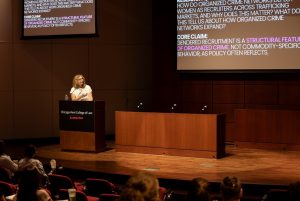
On June 10, 2026, I had the honor and privilege to present my preliminary thesis research at the Chicago-Kent College of law in Chicago, Illinois. I am extremely grateful for the opportunity, and to have been funded by El Instituto’s Elizabeth Mahan Fund for Graduate Studies in Latin American and Latino Studies. I thank those who were involved in the award delegation process.
To reflect upon my experience at the Metra Conference, I am extremely grateful and ecstatic that I was able to attend. Prior to my presentation, I was able to speak with law enforcement officers, social workers, and advocates in attendance to understand what kinds of counter-human trafficking strategies and operations. Many people had interest in understanding what I was going to be presenting on and wanted my information to contact at a later date. The presentation itself went smooth, and I had even more attendees approach me after I spoke to collaborate and work together to help combat trafficking in all fronts. I was excited to have been able to demonstrate the connections across human, drug, and weapon trafficking, which from what advocates and law enforcement explained after, will help them rethink cases.
The actual results of my research are still in their preliminary stages, but I was happy to share some of the connections I have already been able to make. My research found that women in organized crime are not simply peripheral actors or victims but often occupy a consistent and strategic role as recruiters who connect new individuals to trafficking networks. Across diverse cases involving sex, drug, and firearms trafficking, recruitment emerges as a distinct organizational function centered on managing relationships, trust, and entry into the network. These recruitment processes rely less on force and more on pre-existing social ties, like family, romantic relationships, and community connections. This often makes them difficult to detect and highly structurally effective. Women frequently act as intermediaries or “buffer nodes,” absorbing risk and visibility while protecting higher-level leadership, which helps networks remain resilient and adaptable. My research also shows that individuals can move along a victim–perpetrator continuum over time, with prior victims sometimes becoming recruiters, reflecting an organizational strategy rather than contradiction. Importantly, recruitment structures facilitate “market convergence,” meaning the same trust-based pipelines are used across different types of trafficking activities. Because courts tend to capture only visible or expendable actors, women recruiters are often overrepresented in prosecutions while leadership remains insulated. Overall, my findings argue that trafficking networks are best understood as relationship-based systems, where recruitment – not leadership – is the key driver of growth. One thing that I highlighted is that my research demonstrates major policy implications: effective intervention requires targeting recruitment mechanisms rather than focusing solely on commodities or top-level actors.
I have attached the link to the program and website of the conference, where I was highlighted in the Routes to Safety: A Human Trafficking Conference webpage.