Interim Director selected for CLAS Award

April 10, 2024

Interim Director Charles Venator-Santiago was recently selected as the winner of the 2024 Broader Impacts, Service, and Visibility Award.

This award, as the College of Liberal Arts and Sciences (CLAS) explains, recognizes UConn Faculty members for their work in “outstanding initiatives that visibly impact the welfare of Connecticut and beyond” through community engagement, and developing connections with governmental and non-profit organizations.

ELIN Affiliate Faculty César Abadía-Barrero Research Update

April 3, 2024

César Abadía-Barrero is a jointly appointed Associate Professor of Anthropology and Human Rights. He is also an affiliate faculty member for El Instituto. Check out his spotlight video from the UConn Gladstein Family Human Rights Institute YouTube Page.


César J. Ayala Workshop on the Comparative Study of Race in the Americas

March 29, 2024

Contributed by Apoliana da Conceição dos Santos

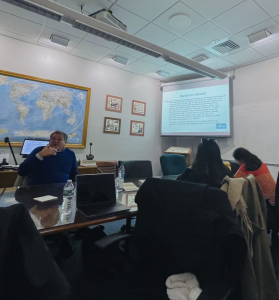
César J. Ayala - Professor of Sociology at UCLA - teaching graduate students about comparative research on race in the Americas. An indoor classroom or conference room setting with several individuals seated around a large table. On the right side of the room, a projector screen displays a slide filled with text in paragraph form, though the text is not fully legible in the image.
César J. Ayala – Professor of Sociology at UCLA – teaching graduate students about comparative research on race; Image by Apoliana da Conceição dos Santos

During the César J. Ayala Workshop on the Comparative Study of Race in the Americas, Professor Ayala illuminated the nuanced nature of racism, emphasizing its variation across different regions. He underscored the ineffectiveness of importing U.S. racism into other contexts, highlighting the unique manifestations of racism in each country. Through thought-provoking questions, he prompted attendees to reflect on the nature of racism and white supremacy in our respective homelands. Professor Ayala’s presentation went through popular concepts such as systemic racism, institutional racism, structural racism, and white supremacy, offering empirical insights and comparative analyses of scholarships. Drawing on studies of racial inequality in Puerto Rico, he provided us with a comprehensive understanding of the complex dynamics at play. Particularly interesting to me were his references to Brazilian perspectives on race, exemplified by the documentary Preto X Branco, which contrasts with American views. Additionally, his recommendation of Edward Telles’ book Race in Another America: The Significance of Skin Color in Brazil further enriched the discourse, offering deeper insights into the complexities of race in the Americas.

In conclusion, it is evident that racism manifests differently across various regions. Importing U.S. racism does not alter the underlying realities of one’s own country. Questions such as ‘What is racism like in your country?’ and ‘What is white supremacy in your country?’ prompt us to consider the unique socio-cultural contexts shaping these phenomena. Furthermore, education correlates with increased awareness of one’s racial identity. Ultimately, acknowledging these complexities is essential for fostering meaningful dialogue and enacting positive change.


Joint Senior Faculty Hire Between the Department of Sociology & El Instituto

February 5, 2024

Contributed by Charles R. Venator Santiago

We are currently conducting a search for a senior scholar with a joint appointment in the Department of Sociology and El Instituto. Three finalists will visit our campus on February 7th (Professor Salvador Vidal-Ortiz, American University), February 9th (Marta Maldonado, Oregon State University), and February 12th (Elizabeth M. Aranda, University of South Florida). Feel free to contact El Instituto’s general email (elinstituto@uconn.edu) if you want to join the following job talks:

1. Friday, February 9: Marta Maldonado (3:30 PM) – Job Title Talk: Uno Se Las Arregla’: Latinos Managing Precarity on the Oregon Coast

2. Monday, February 12: Elizabeth M. Aranda (3:30 PM) – Job Title Talk: You Can’t Have It All, There Is Always a Give and Take: Post-Disaster Migrants’ Return to Puerto Rico

CALAHE Annual Conference

Contributed by Charles R. Venator-Santiago

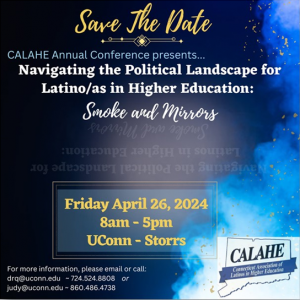
A “Save the Date” graphic for the CALAHE Annual Conference. The background features a dark blue and black gradient with bright blue and gold splashes of color on the right side. At the top, large cursive yellow text reads “Save The Date.” Below, white text announces: “CALAHE Annual Conference presents… Navigating the Political Landscape for Latino/as in Higher Education: Smoke and Mirrors.” A centered navy-blue box with a gold border contains event details in yellow text: “Friday April 26, 2024, 8am – 5pm, UConn – Storrs.” In the lower right corner is the CALAHE logo, which includes the outline of the state of Connecticut and the organization’s name. At the bottom, white text provides contact information for more details and registration. The Connecticut Association of Latinos in Higher Education (CALAHE) will celebrate its annual conference on April 26, 2024, on the UConn Storrs Campus. The conference theme is: Navigating the Political Landscape for Latino/as in Higher Education: Smoke and Mirrors. Please visit the CALAHE website for more information. El Instituto and the Puerto Rican Studies Initiative are supporting this event.
Update on NDOU Department

Contributed by Charles R. Venator-Santiago

As I noted in the previous issue of La Voz, for more than 3-years the leadership of the NDOUs has debated the creation of a new interdisciplinary department to house all units. During the fall of 2023, a majority of the faculty of El Instituto and the Africana Studies Institute voted against joining the new department. A majority of the faculty of El Instituto thought that joining a new department would create unreasonable labor expectations and prefer to work in an institute that is focused on Puerto Rican, Latino/a, Caribbean and Latin American studies. The other four institutes will join in the creation of a new department (yet to be named). Our faculty supports their decision and stands in solidarity with our colleagues.

El Instituto logo featuring a stylized circular floral motif in red, orange, and yellow tones, with small blue accents. Inside the circle is a simplified map of the Americas in white on an orange background. To the right of the emblem is the text “El Instituto” in large red letters. Below it, in smaller text, it reads: “Institute of Latina/o, Caribbean, and Latin American Studies."

New PRSI Dashboards

Contributed by Charles R. Venator-Santiago

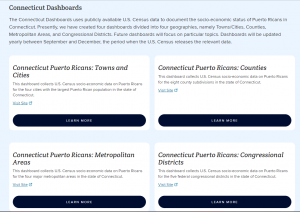
PRSI Website dashboard snapshot: A webpage section titled “Connecticut Dashboards” displays four information cards about Puerto Rican demographic data in Connecticut, based on publicly available U.S. Census data. At the top, a paragraph explains that the dashboards document the socio-economic status of Puerto Ricans in Connecticut and that four dashboards are currently available: Towns and Cities, Counties, Metropolitan Areas, and Congressional Districts. Each card includes a brief description and a navy-blue “Learn More” button. The four cards read:“Connecticut Puerto Ricans: Towns and Cities” — describing socio-economic data for Puerto Ricans by town or city.
“Connecticut Puerto Ricans: Counties” — describing socio-economic data by county.
“Connecticut Puerto Ricans: Metropolitan Areas” — describing data for metropolitan areas.
“Connecticut Puerto Ricans: Congressional Districts” — describing data by congressional district.
PRSI Connecticut Dashboards

UConn’s Puerto Rican Studies Initiative (PRSI) is releasing a series of data dashboards designed to provide public access to different types of demographic and archival data addressing different dimensions of the Puerto Rican experience with the help of UConn Graduate students.


We have created dashboards addressing various demographic dimensions of Puerto Ricans in Connecticut and an interactive dashboard addressing various demographic dimensions of Puerto Ricans in the Northeast. The dashboard is available on the Puerto Rican Studies Initiative website.


In addition, we have developed an interactive dashboard to study the history of political status legislation for Puerto Rico. The data can be accessed through the Tableau Public platform.


We are in the process of creating several additional dashboards that address the demographic dimensions of Puerto Ricans in the United States.

Building a Better Future: The Latino and Puerto Rican Policy Agenda Summit

Contributed by Charles R. Venator-Santiago

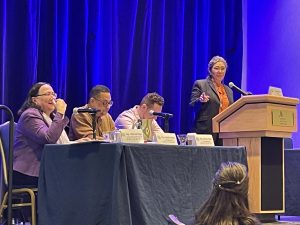
From Left to Right: State Rep. Hilda Santiago (Meriden); Rep. Geraldo Reyes (Waterbury); Rep. Antonio Felipe (Bridgeport); Ana Alfaro (Moderator) speaking to the audience.
From Left to Right: State Rep. Hilda Santiago (Meriden); Rep. Geraldo Reyes (Waterbury); Rep. Antonio Felipe (Bridgeport); Ana Alfaro (Moderator).

On January 20, 2024, we celebrated Connecticut’s first Latino and Puerto Rican Policy Summit. Our goal is to establish a comprehensive non-partisan agenda for the Latino community in Connecticut. The event was titled Building a Better Future: The Latino and Puerto Rican Policy Agenda Summit and was held at the Marriot Downtown Hotel. The goals of the agenda included:


  • To provide essential information to policymakers, encourage civic participation, and address critical gaps in data analysis for our community.
  • The summit serves as a platform to inform and enhance leadership within the Latino community, empowering community leaders, elected officials, and advocates.
  • Beyond agenda-setting, the event provides a unique space for networking, fostering connections and collaborations within and beyond the Latino community.
  • Provide essential information to policymakers, ensuring that the needs and concerns of Latinos in Connecticut are given due consideration.
  • Promote active civic participation by disseminating accurate and accessible information on current socio-political issues, encouraging proactive engagement and informed decision-making within the Latino community.
  • Consolidate the themes and priorities expressed during the preceding community dialogues into a comprehensive report for further discussion and distribution.
  • Facilitate networking opportunities by creating a platform for attendees to connect, collaborate, and build meaningful relationships within and beyond the Latino community.
  • Unveil innovative data tools that will address critical gaps in data analysis for the Latino community. These tools will empower our community and lawmakers with comprehensive, up-to-date information for informed decision-making and advocacy.


For more information, please visit the Puerto Rican Studies Initiative webpage dedicated to this event.

Congratulations to our Colleague Rodolfo Fernandez!

Contributed by Charles R. Venator-Santiago

Selfie of Professor Rodolfo Fernández smiling at the camera.

Please join us in celebrating our colleague Rodolfo Fernandez, who received two awards from the Provost’s Competition Common Curriculum Grant Competition to develop two TOI-3 (creativity) courses. The selection committee wrote that it “was very impressed with your proposal and voted for your course development.” Professor Fernandez will be developing a course titled: “LLAS/HIST 2630 Role Playing Revolutionary Mexico” and a course titled: “LLAS/HIST 1630W Latin American Histories through Popular Cultures.”