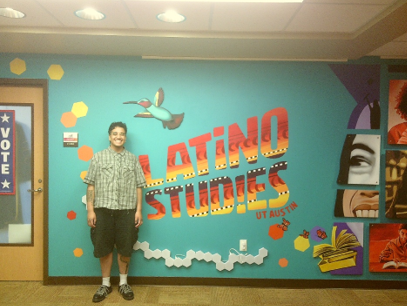
Contributed by Julien Torrento
As a Mahan fellow, I participated in the summer institute at the Voces Oral History Center at the University of Texas at Austin, the leading Latino oral history archive in the United States. Through this fellowship-funded research, I received training in oral history methodology as well as the standards and practices that guide oral histories within the broader research community. The experience provided me with methodological tools that have expanded how I understand my own research on embodiment, identity formation, and cuir experience.
One of the most significant outcomes of my fellowship is developing a deeper understanding of oral history as a form of memory work. Oral history differs from other forms of historical research in its attention to orality, sound, narrative form, subjectivity, and the ways memory changes over time. The value of oral testimony does not solely depend on its adherence to factual accuracy, rather, the ways people remember, interpret, or narrate their experiences can reveal forms of knowledge that conventional historical records may not capture. I also learned the importance of the intersubjective relationship between interviewer and interviewee. Oral history is dependent upon relationship building, patience, and time, with new questions and interpretations often emerging through each interview experience. This approach has encouraged me to think more carefully about how histories are constructed and about the relationships through which knowledge is produced.
This training has directly enriched my current research on Roque Salas Rivera’s Algarabia. My work examines embodiment and identity formation through lived experiences within the cuir community. In Algarabía, Cenex, the epic hero, struggles to establish a name, body and stable home while navigating institutions that are against him doing so. The poem’s relationship to oral tradition is particularly significant to my research because Salas Rivera draws upon the epic poem, a form traditionally meant to be spoken and passed on through oral tradition. This raises questions about how stories, histories, and identities are transmitted when they move between oral and written forms.
Although the form Salas Rivera presents is a written literary text, this relationship between reader and narrator can resemble the intersubjective relationship between interviewer and interviewee: the narrative is not delivered as a complete or objective history, but is constructed through an encounter with fragments, voices, and materials that require interpretation. Salas Rivera combines the poem with art, quotations, court rulings, and other forms of documentation, creating a complex process of establishing and reconstructing a narrative. This complexity resonates with a central question in my research: what does it mean to search for where you are from, particularly from a positionality shaped by institutional power and an unstable relationship to identity? Rather than providing a singular origin story, Algarabía demonstrates how histories and identities can be assembled through encounters with archives, testimony, memory, and other people’s accounts.
The Mahan Fellowship has consequently expanded both the scope and methodology of my research. My training at the Voces Oral History Center has given me a stronger foundation for placing literary analysis into conversation with oral histories and for attending to the relationships between narrative, memory, embodiment, and history. Moving forward, I hope to continue bringing oral testimony into conversation with literary texts, particularly in examining how trans and cuir communities narrate, preserve, and create meaning around experiences of identity, embodiment, and belonging. The fellowship has provided me not only with new research skills, but with a methodological framework for understanding storytelling itself as a process through which histories and identities are continually constructed.