Contributed by graduate student Luis Palomino.
My research focuses on spatial economics and regional development. I study local development economics using unstructured and structured data and machine learning methods. A key goal of my doctoral preparation is to build fine-grained measures of economic activity that can be linked to official statistics and applied across countries. In this context, attending the ASSA 2026 Annual Meeting (January 3–5, 2026, Philadelphia) was important for improving my methods, refining my research direction, and connecting with scholars in urban, spatial, and development economics.
The Whetten Latin American Studies Fellowship Fund provided USD 685 in Fall 2025, which was used only for conference expenses. The funds covered round-trip transportation, three nights of lodging near the venue, student registration, the AEA Mentoring and Networking Luncheon fee, and local transportation and meals. These expenses enabled full participation in conference sessions and professional events.
I attended multiple sessions: Advances in Computational Economics; Studies in Development Economics; Measuring Development – New Tools; Advances in Spatial Economics; Machine Learning, Prediction Errors, and Causal Inference; Measuring Misallocation and Reallocation. Chairs included Jesús Fernández-Villaverde, Manaswini Rao, Edward Glaeser, Pascaline Dupas, Dave Donaldson, Matthew Gordon, Jonathan Dingel, Stuart Rosenthal, and Kunal Sangani. The presentations highlighted new ways in spatial economics and economic measurement using machine learning for unstructured data — such as satellite imagery, text, and mobile phone records — which are central to my current work.
I also participated in the AEA Mentoring and Networking Luncheon at the Urban and Spatial Economics table led by Professor Edward Glaeser. The 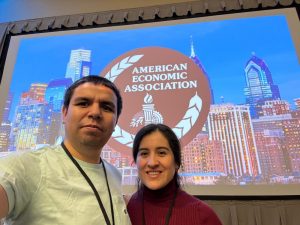 discussion focused on the research of each panel member, urban and spatial economics research, and career development. At the ASSA sessions and events, I spoke with graduate students and researchers about data construction, replication, and collaboration using large-scale spatial datasets.
The conference helped refine how I will incorporate uncertainty and benchmarking into spatial allocation models. These ideas apply to my dissertation on regional development in Peru and to a related project on fine-grained GDP measurement in the United States using satellite and labor data, aligned with current NBER priorities on economic measurement.
Overall, the fellowship enabled full participation in ASSA 2026. The training, feedback, and professional connections gained will guide the next stages of my doctoral research and future grant proposals.